Pan-African Feminist Alliance · Press Release · May 2026
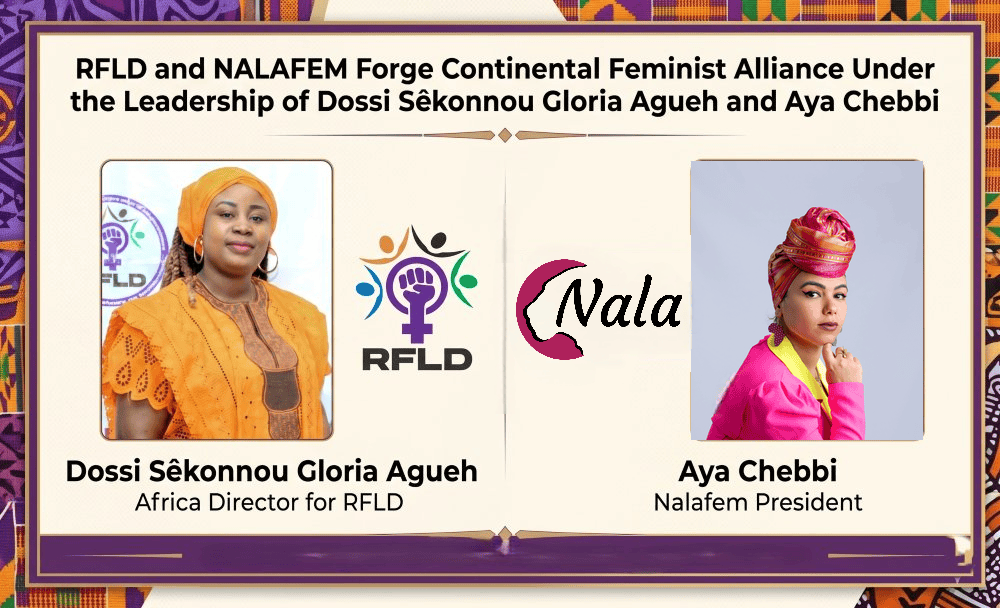
Power Meets Capital: RFLD and NALAFEM Forge Continental Feminist Alliance Under the Leadership of Dossi Sêkonnou Gloria Agueh and Aya Chebbi
A two-year Framework MoU signed between the Réseau des Femmes Leaders pour le Développement and Nalafem places two of Africa’s most consequential pan-African feminist collectives at the helm of a new pan-African solidarity architecture — one designed to bridge the francophone–anglophone divide, deepen co-programming and advocacy across the continent, and build durable feminist infrastructure led by African women.
Accra / Nairobi — May 2026
In a quietly historic move that will reshape the architecture of feminist philanthropy on the African continent, the Réseau des Femmes Leaders pour le Développement (RFLD) and Nalafem have signed a two-year Framework Memorandum of Understanding (2026–2028) establishing a structured, multi-year partnership for feminist solidarity, joint programming, advocacy, subgranting pathways, and shared resource mobilisation.
The agreement — concluded between RFLD’s Accra Regional Hub and Nalafem — is signed at the highest executive level: Mme Agueh Dossi Sêkonnou Gloria, Executive Director of RFLD, and Ms. Aya Chebbi, Founder and President of Nalafem. Their joint signature inaugurates one of the most ambitious cross-network feminist alliances seen on the continent in recent years.
A Partnership Born of Strategic Vision
The Framework MoU is grounded in a shared diagnosis of the African feminist landscape: women political leaders, capital-holders, grassroots organisers, and policy infrastructure too often work in parallel rather than in concert. Francophone West Africa and anglophone Africa rarely share funding streams. Continental advocacy is fragmented. And the organisations closest to lived realities are too often the last to be resourced.
The RFLD–Nalafem partnership is designed to close those gaps.
Dossi Sêkonnou Gloria Agueh is the Founder and Executive Director of RFLD, which she established in 2013. She leads the organisation’s continental strategy, institutional partnerships, and governance engagement across the African Union system. Under her leadership, RFLD has secured Observer Status with the African Commission on Human and Peoples’ Rights (ACHPR) and sits as a Member in the Working Group of the ACHPR Special Rapporteur on Human Rights Defenders. Gloria was selected by the African Union African Governance Architecture as Youth Ambassador for the Governance Continental Roadshow Campaign. She sits on the Steering Committee of the CHARM Africa Consortium (funded by Sida since 2018), and in 2026 RFLD assumed the Presidency of the GIZ/BMZ Africa SEA-T Advisory Council — a historic milestone for francophone African feminism. Gloria holds a Master’s degree in Communications and Project Management and is currently a PhD candidate.
RFLD operates from offices in Accra (Anglophone operations), Porto-Novo, Dakar (Sahel programmes), and Banjul (ACHPR Liaison Office). The network convenes 670 member organisations across 15+ African countries, is certified as NGOsource 501(c)(3) Equivalent for United States philanthropy, and has emerged as one of the most operationally sophisticated francophone-anchored feminist infrastructures on the continent.
Under the leadership of Aya Chebbi — pan-African feminist, former African Union Special Envoy on Youth, and one of the most recognisable young political voices of her generation — Nalafem has built itself into a convening power that brings together women political leaders, advocates, capital-holders, and grassroots organisers under a single banner. Nalafem’s annual Summit has become one of the continent’s most-watched platforms for women’s political leadership. Nalafem is registered in Kenya but works across 42 countries. Established in 2021 at the Generation Equality Forum, Nalafem champions the Africa Young Women Beijing +25 Manifesto and since its inception has impacted 50,000+ women.
The MoU formally locks these two infrastructures into a single, structured, two-year programme of cooperation.
RFLD · Founder & Executive Director
Mme Agueh Dossi Sêkonnou Gloria
Founder of RFLD (est. 2013). Leads continental strategy, institutional partnerships, and governance engagement across the African Union system. AU AGA Youth Ambassador. PhD candidate.
Nalafem · Founder & President
Aya Chebbi
Pan-African feminist, former African Union Special Envoy on Youth, and one of the most recognisable young political voices of her generation. Founded Nalafem in 2021 at the Generation Equality Forum; impact across 42 African countries.
The 5th Nalafem Summit — Inaugural Activity
The inaugural activity under the Framework MoU is the 5th Nalafem Summit, to be held on 1–2 July 2026 at the Emara Ole Sereni Hotel in Nairobi, Republic of Kenya, under the theme “Power Meets Capital: When Women Back Women.”
As Strategic Partner, RFLD will field a delegation drawn from its network across the Ouagadougou Partnership countries, including grassroots women leaders. The partnership includes joint design of at least one plenary session and one closed Power & Capital roundtable with francophone-focused composition curated by RFLD, full visibility in Summit branding, programme booklet and partner announcements, and a recognition award option to be conferred on a young woman leader during the Summit ceremony.
French-language interpretation will be coordinated jointly — a deliberate, programmatic gesture toward the francophone–anglophone bridge the MoU explicitly seeks to build.
Beyond the Summit: Subgranting, Learning, Co-Advocacy
The Framework MoU extends well past the July 2026 Summit. Across its two-year term, the Parties commit to:
- Subgranting pathway — Nalafem may nominate eligible organisations for consideration by RFLD’s re-granting vehicles, including the Women’s Africa Feminist Fund (WAFF Fund), the Africa Grant Portfolio, and Rapid-Response Grants for Women Human Rights Defenders — with a co-flagged pathway for francophone West African applicants. Selection remains the sole prerogative of RFLD’s grants committee, applying its published due-diligence, PSEAH, and compliance criteria.
- Learning exchange — quarterly virtual learning circles, in-person co-convenings, short-term staff secondments, peer-mentoring of young women political leaders, and co-design of training curricula, including curriculum contributions to the Nalafem Academy.
- Joint advocacy — coordinated representation at the African Union, the African Commission on Human and Peoples’ Rights, the Commission on the Status of Women, ECOWAS, and sub-regional bodies — with RFLD facilitating Nalafem’s engagement at ACHPR sessions through its Observer Status.
- Co-produced knowledge — at least one co-branded thematic brief or policy paper per year, anchored in evidence from RFLD’s DONUESE Data Center and Summit-generated insights.
- Joint resource mobilisation — with the Africa Philanthropy Network and bilateral and multilateral funders, beginning immediately after the 5th Summit.
What makes this Framework MoU consequential is not only its scope but its signatories.
Dossi Sêkonnou Gloria Agueh founded RFLD in 2013 and has, over more than a decade, built it into a feminist institution that operates simultaneously in the spaces of grants administration, ACHPR advocacy, AU governance engagement, donor compliance, and grassroots accompaniment — an unusual combination on the continent. Her trajectory reads as the institutional CV of the contemporary African feminist movement: Member of the Working Group of the ACHPR Special Rapporteur on Human Rights Defenders; African Union African Governance Architecture Youth Ambassador for the Governance Continental Roadshow Campaign; Steering Committee member of the CHARM Africa Consortium (Sida-funded since 2018); and in 2026, President of the GIZ/BMZ Africa SEA-T Advisory Council — a historic milestone for francophone African feminism. Her decision to anchor this partnership through RFLD’s Accra Regional Hub rather than its Cotonou headquarters is itself a strategic statement: it locks the agreement into Ghanaian law and signals RFLD’s deepening anglophone operational footprint.
Aya Chebbi has spent the same decade building the political and convening infrastructure on the other side of the partnership — moving the conversation about African women’s leadership from advocacy to power, and now, with the Nairobi Summit theme, into a deliberate dialogue between political leadership and grassroots organising. Her presidency of Nalafem has made the Collective one of the most consequential platforms for women’s political leadership on the continent.
Together, their signatures on this MoU mark a structural moment: two African feminist institutions, led by two African women at the executive level, committing in writing to co-build the infrastructure their movements have long needed.
“This partnership is not a transaction. It is a structural alignment between two infrastructures that the African feminist movement has long needed to see in writing. With Nalafem, we are building the bridge between political leadership and grassroots organising — and we are doing it in both languages this continent speaks.”
“When women back women, we change the calculus of what is legitimate and what is possible. With RFLD, we are building the bridge between the women who hold political power and the women who do the work, and we have been building it for five years. Showing up in support and strategy when and where women dare to lead.”
About the Parties
Réseau des Femmes Leaders pour le Développement (RFLD)
Pan-African feminist network founded in 2013 by Mme Agueh Dossi Sêkonnou Gloria, with regional offices in Accra, Porto-Novo, Dakar and Banjul. Convenes 670 member organisations across African countries. ACHPR Observer Status. Member, Working Group of the ACHPR Special Rapporteur on Human Rights Defenders. NGOsource 501(c)(3) Equivalent. 2026 Presidency of the GIZ/BMZ Africa SEA-T Advisory Council. Steering Committee member, CHARM Africa Consortium (Sida-funded). rflgd.org
Nalafem
Nalafem is a Pan-African, multigenerational collective advancing African women’s political leadership by shifting the power of convening, funding, and politics to young feminists. They exist to bridge activism and policymaking, and connect local struggles to continental and global change.
- 50,000+ women and girls impacted across 42 African countries
- 15,000+ leadership certifications through the Nalafem Academy
- 47 grassroots feminist initiatives funded
- 4 Nalafem summits convened with 1,000+ women leaders (Nairobi, Windhoek, Freetown, Abuja)
Media Contacts
RFLD: John Gbenagnon, Development Director — partnerships@rflgd.org
Nalafem: Syeda Re’em Hussain — reem@nalafem.org
Issued by the Office of the Executive Director, RFLD Accra Regional Hub, in coordination with the Office of the President, Nalafem.