

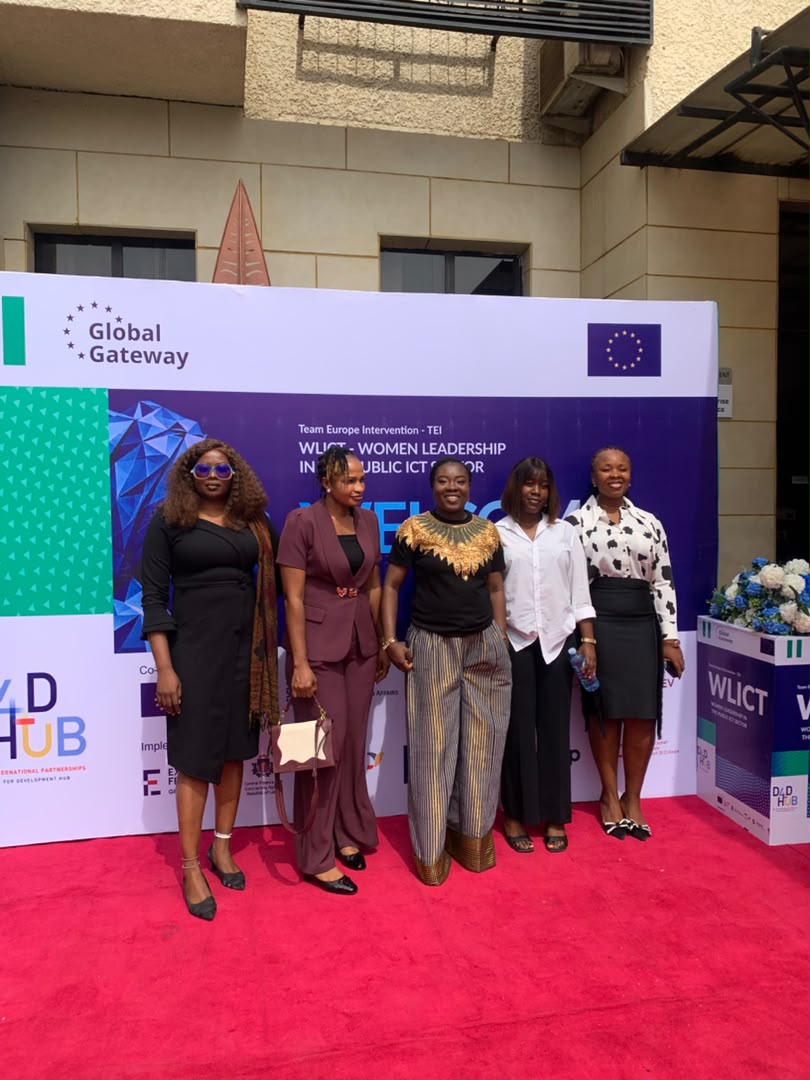
From 6 to 7 October 2026, the Women Leaders Network for Development (RFLD) took part in the WLICT National Consultation and Planning Workshop on Technology-Facilitated Gender-Based Violence (TF-GBV) in Abuja, Nigeria. RFLD was represented by its Nigeria Country Representative, Simbiat Bakare.
The workshop brought together civil society organisations, national institutions, media and technology practitioners. Its aim was to agree on priorities for preventing and responding to TF-GBV in Nigeria, and to strengthen the participation and leadership of women in the public information and communication technology sector.

About the WLICT initiative
Women Leadership in the Public ICT Sector (WLICT) is a 36-month Team Europe initiative implemented by a consortium of European cooperation agencies, with Expertise France among the implementing partners. It is aligned with the European Union’s priorities on digital transformation, gender equality and multilateralism. In each partner country, the initiative supports practical changes to address technology-facilitated violence and to open more space for women in digital governance.
The Abuja consultation is part of the national planning phase. Its conclusions will shape the activities supported in Nigeria in the coming months.
A problem that keeps changing
Participants agreed that TF-GBV in Nigeria is growing and changing fast. Women and girls face cyberbullying, stalking, online harassment, the non-consensual sharing of intimate images and doxxing. New forms of abuse enabled by artificial intelligence are adding to the risk. Women who are visible in public life, including journalists, activists and politicians, are frequent targets.
Several gaps came up again and again. Nigeria has no national baseline data and no mechanism to track TF-GBV over time. Survivors often do not know where to report. When they do report, police units and justice institutions are not always equipped to respond. Psychosocial and legal support remains hard to find, especially outside major cities. Persons with disabilities and young people are often left out of awareness efforts and services.

RFLD’s contribution
Simbiat Bakare contributed to the group discussions that mapped where efforts to end TF-GBV get stuck. RFLD stressed that the main bottlenecks are institutional. Platforms do not have enough measures in place to prevent abuse, and law enforcement too often fails to hold perpetrators to account.
RFLD also took part in the thematic working group on the accountability of technology companies, governments and States in protecting women, girls and gender non-conforming people online. The group noted that the large platforms frequently fall short of their responsibilities to users. It proposed to use existing Nigerian laws to hold them to account, including the Cybercrimes Act, the Nigeria Data Protection Act, the Violence Against Persons (Prohibition) Act, consumer protection law and the criminal and penal codes.
Because TF-GBV crosses borders, perpetrators sometimes live in a different country from the survivor. This makes access to justice harder. The group called for cross-border cooperation through bilateral and multilateral agreements. Its recommendations include:
- Mapping the platforms where TF-GBV is most common and the groups most exposed to it.
- Reviewing platform policies against national protection laws.
- Opening a dialogue with social media companies to identify gaps, and working with them on tools and protocols to prevent and respond to TF-GBV.
- Engaging government agencies and diplomatic missions on agreements that address perpetrators based abroad.
- Working with the National Assembly on sanctions for platforms that do not comply.
Finally, RFLD contributed to the design of a steering committee for the national work plan. RFLD proposed a small formal group to oversee priorities and follow the implementation of recommendations, bringing together civil society, government institutions, media and technology experts.
What the other working groups proposed
The workshop was organised around thematic tables. Each produced recommendations and named organisations committed to follow-up. The main proposals were:
- Evidence. Conduct a national TF-GBV baseline assessment, explore a Nigeria TF-GBV Index and publish annual reports to track trends. A multi-stakeholder technical working group would develop the methodology.
- Schools. Integrate digital safety and security into the Family Life and HIV Education curriculum, train teachers to respond to TF-GBV and create digital safety clubs with peer champions.
- Reporting. Constitute a case management team, develop standard operating procedures, a reporting template and a clear referral pathway to tackle under-reporting.
- Media. Run awareness campaigns on rights, consent and reporting channels through radio, billboards, social media and community town halls, with content adapted to children, adults and persons with disabilities.
- Survivor support. Create support groups, map mental health providers across the country and set up support funds to cover legal costs and mediation.
- Inclusion. Build accessibility into existing apps and programmes, increase budgets for disability inclusion and support youth-led initiatives on TF-GBV.
- Capacity. Train organisations in trauma-informed care and advocacy, and agree on a national template for documenting and reporting cases.
Next steps
Expertise France will take forward the recommendations from civil society and share a report with participants. Participants will be engaged in upcoming workshops and focus groups, and calls for applications are expected in the coming months.
RFLD will contribute to the follow-up on the accountability of technology companies and States, in line with its commitment at the workshop. The Abuja discussions will also inform RFLD’s work at the 89th Ordinary Session of the African Commission on Human and Peoples’ Rights in Dakar. On 13 October, RFLD joins a regional dialogue with Expertise France under the WLICT initiative on TF-GBV, with civil society and national institutions from Benin, Nigeria and Senegal. The full schedule is on our programme page for the 89th Session.
RFLD is a Pan-African Afrofeminist network founded in 2013, bringing together 1,143 member organisations in more than 35 countries. Its Nigeria office in Lagos works with women’s organisations and women human rights defenders on digital safety, participation in public life and protection from violence.


