
The Maputo Protocol in your language
A right you cannot read is a right you cannot claim. RFLD translates the Protocol on the Rights of Women in Africa into African languages, so that women, community leaders, paralegals and officials can read it, hear it and use it.
Choose a language About the Protocol
Read the Protocol in eight African languages
Each version can be read online as plain text, which works on a phone, can be searched and is read aloud by screen readers. Each one can also be downloaded as a PDF to print and share.
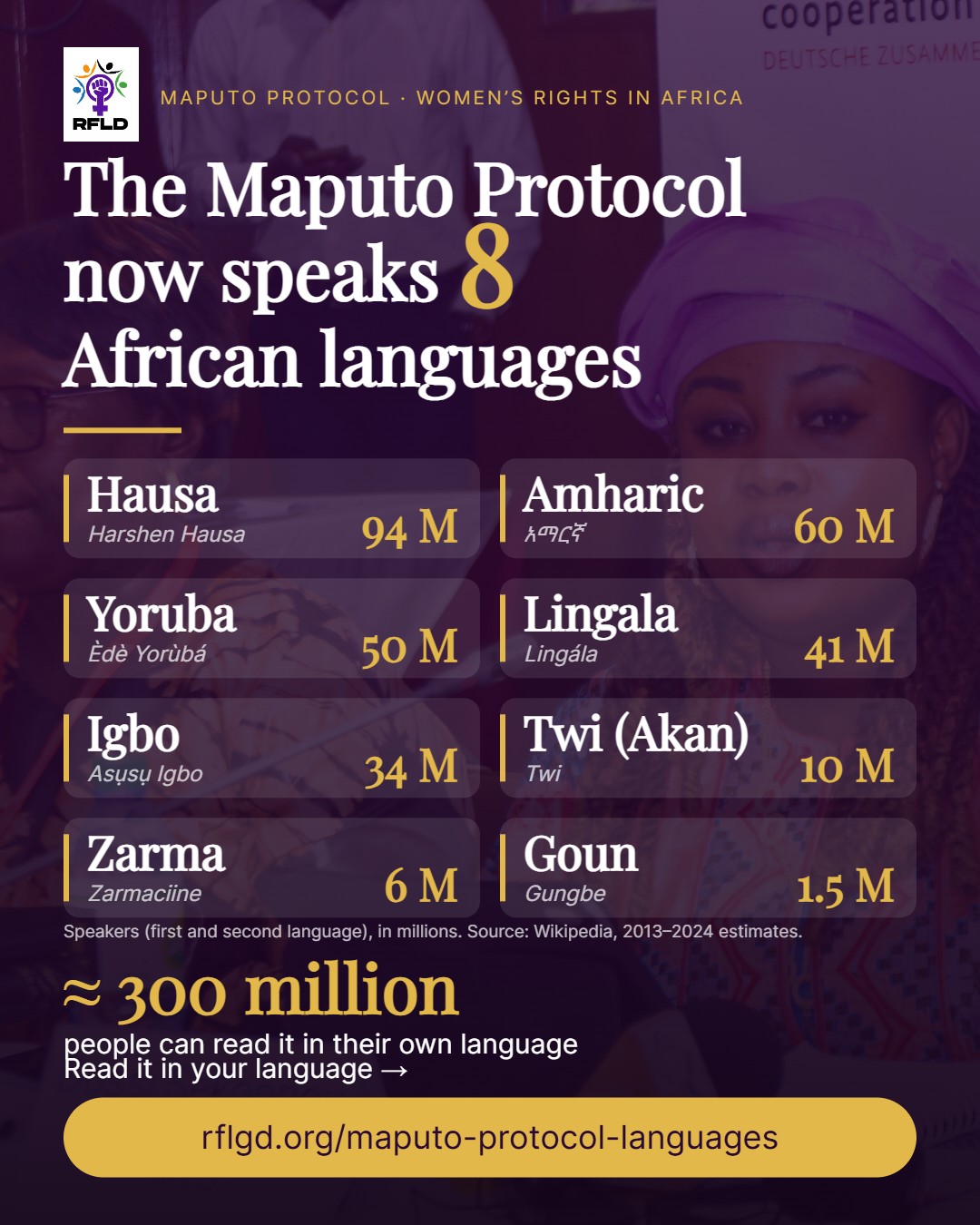
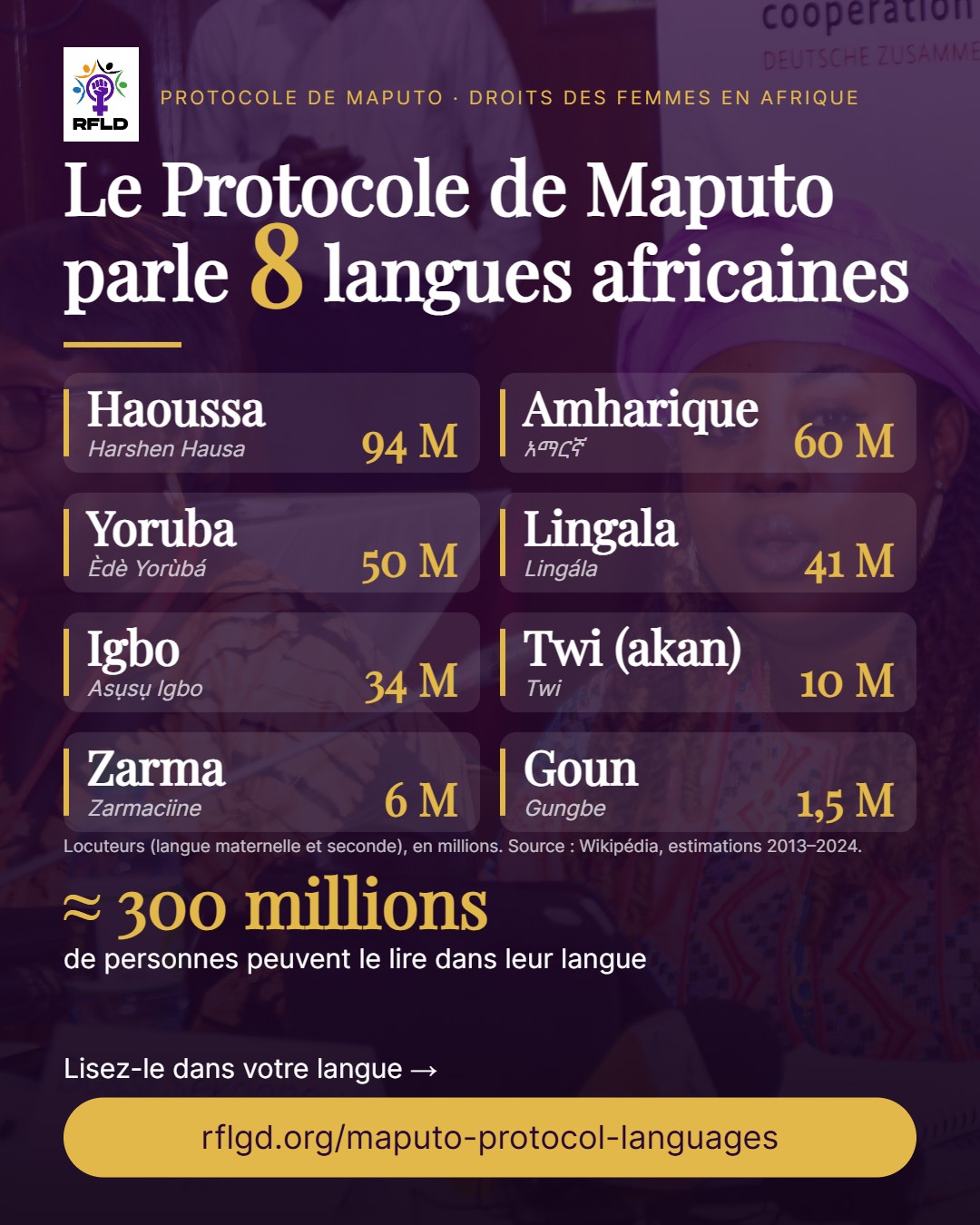
Nearly 300 million speakers, one text
Each bar shows how many people speak the language as a first or second language. Together, the eight translations put the Protocol within reach of nearly 300 million people across West, Central and East Africa.
Speakers in millions, first and second language. Source: Wikipedia, estimates from 2013 to 2024.
Eight rights every woman can now read in her language
The Protocol has 32 articles. These are among the provisions women, paralegals and community leaders use most often.
Elimination of discrimination
States commit to end discrimination against women in law and in practice.
Life, integrity and security
Every woman is protected against all forms of violence, in public and in private.
Harmful practices
States must prohibit and condemn female genital mutilation and other harmful practices.
Marriage
Marriage requires the free consent of both spouses, and the minimum age of marriage for women is 18.
Political participation
Women take part in elections and in decision-making on an equal footing with men.
Health and reproductive rights
Women decide on their fertility and have access to health services, including family planning.
Inheritance
Widows and daughters inherit property on an equal basis with men and sons.
Implementation
States report on the measures they take, in their periodic reports to the African Commission.
Bring the Protocol to your community
Send the link to a women’s group, a radio station or a community leader. Download the visuals and post them in French or English.
Other languages
The Protocol was adopted in the official languages of the African Union. Other members of the Solidarity for African Women’s Rights coalition (SOAWR) have produced further translations. We link to them here so that no one translates the same text twice.
| Language | Type | Where to find it |
|---|---|---|
| English | Official text | Download (OHCHR) |
| French | Official text | Download (SOAWR) |
| Portuguese | Official text | Download (SOAWR) |
| Arabic | Official text | SOAWR page |
| Kiswahili, Kinyarwanda, Chichewa | Partner translations | SOAWR page |
| Simplified English | Plain-language version | Download (SOAWR) |
Audio versions
Many women learn through radio and voice messages. RFLD recorded the Protocol in Hausa and Zarma for Niger, and in Goun and Yoruba for Benin.
Hausa
Zarma
The Goun and Yoruba recordings are listed on the SOAWR audio page.
From the treaty text to the community
Official source
We start from the text adopted by the African Union Assembly in Maputo on 11 July 2003.
Full translation
The preamble and all 32 articles are translated, with the same numbering as the original.
Review
Native speakers and lawyers check terms, meaning and spelling. Corrections are added to each new version.
Community test
Women’s groups read the text in workshops and tell us what is unclear.
Web, PDF and audio
Each version goes online as text, as a PDF and, where possible, as audio.
From reading to action
Frequently asked questions
What is the Maputo Protocol?
The Protocol to the African Charter on Human and Peoples’ Rights on the Rights of Women in Africa was adopted by the African Union in Maputo on 11 July 2003. It sets out the rights of women and girls and the duties of the States that ratify it.
How many countries have ratified it?
46 of the 55 African Union member states have ratified the Protocol.
Which languages has RFLD translated?
Amharic, Igbo, Lingala, Twi, Hausa, Zarma, Goun and Yoruba. Four of these translations were completed in 2026.
How many people speak these languages?
Nearly 300 million people speak the eight languages as a first or second language, according to Wikipedia estimates from 2013 to 2024.
Can I listen to the Protocol?
Yes. Audio versions exist in Hausa, Zarma, Goun and Yoruba.
Can I use these translations in my training?
Yes. The texts are free to read, print and share. Please credit RFLD and link to this page.
Help us add your language
Do you speak Wolof, Pulaar, Bambara, Mooré, Fon, Mandinka or another African language? We are looking for volunteer reviewers and partner organisations to check our translations and to start new ones. Write to us with the language you speak and your experience.
These translations are unofficial and are produced for information, training and advocacy. Only the texts adopted by the African Union are authentic. The 2026 translations into Amharic, Igbo, Lingala and Twi are open for review; corrections are welcome.
For funders and partnersPour les bailleurs et les partenaires
Fund the women who defend rights in Africa, nowFinancez maintenant les femmes qui défendent les droits en Afrique
Aid to women’s organisations is falling. RFLD moves funding fast to women-led organisations and defenders, in French and English, through a network of 1,143 member organisations in more than 35 African countries.L’aide aux organisations de femmes recule. Le RFLD achemine vite les financements vers les organisations de femmes et les défenseures, en français et en anglais, grâce à un réseau de 1 143 organisations membres dans plus de 35 pays africains.
RFLD currently serves as Co-Chair of the SEA-T Programme Advisory Council, mandated to ensure the programme’s direction, priorities, and resources are meaningfully aligned with the visions of African women-led civil society. The SEA-T Programme is funded by the German Federal Ministry for Economic Cooperation and Development (BMZ) and implemented by the Deutsche Gesellschaft für Internationale Zusammenarbeit (GIZ) GmbH.Le RFLD assure actuellement la coprésidence du Conseil consultatif du programme SEA-T, chargé de veiller à ce que l’orientation, les priorités et les ressources du programme soient réellement alignées sur les visions de la société civile africaine portée par les femmes. Le programme SEA-T est financé par le ministère fédéral allemand de la Coopération économique et du Développement (BMZ) et mis en œuvre par la Deutsche Gesellschaft für Internationale Zusammenarbeit (GIZ) GmbH. See the partnershipVoir le partenariat
- 1,143member organisationsorganisations membres
- 35+African countriespays africains
- N°553ACHPR observer statusstatut d’observateur CADHP
- CandidPlatinum Seal of Transparency 2026Sceau de transparence Platine 2026
DonateFaire un don Partner with RFLDDevenir partenaire See our financialsVoir nos états financiers